P.C. Ramakrishna, veteran theatre actor and director, recounts to Saritha Rao Rayachoti some of the high points of his 50-year association with English Theatre.
Friday, February 06, 2015
Centre Stage - P.C. Ramakrishna
P.C. Ramakrishna, veteran theatre actor and director, recounts to Saritha Rao Rayachoti some of the high points of his 50-year association with English Theatre.
Tuesday, September 09, 2014
The Name of the Game
Thursday, March 27, 2014
Made In Chennai - Rehane Yavar Dhala
This is where my husband is, my family is. And I want it all – a career and a family. It doesn't matter where you are based - if you do your job well, the whole world will know how good you are.
After being part of the vibrant fashion scene in Rome, I moved to Chennai, married with a baby. I wanted to express myself through my art, but frustratingly, there were no takers for western wear. I didn't have a label back then, but I got the opportunity to design for Jacqueline Verghese who contested in Femina Miss India (I think in 1996). When I won the Best Designer of the Year award at the pageant, it was a validation of my work.
Lakme Fashion Week Mumbai 2002. It was not just about me - it was about being pitched against so much design talent, so many designers with their own thumb prints from across India, all under one roof. The experience reaffirmed that my designs were unique and distinct.
When I first began in Chennai, I did simple silhouettes with excellent cuts and no embellishments. There were no takers. Sadly, even today, there are no takers for a simple well-cut trouser. It's almost always unsold in my boutique. Nobody even tries it on. But when I wear it, people want to know where I bought it!
More is less. I decided to change my design definition and go the opposite direction - from simple, unembellished to flamboyant, over-embellished design. I have now toned it down a little to strike a balance.
When one of my tailors got married, in his wedding card, under his name, it read, 'Head Tailor for Rehane'. I thought that was very cute!
Belief in myself and dogged determination. Nothing on earth can stop me! I believe everything starts in the mind. So, when someone gave me a copy of Rhonda Byrne's The Secret, none of it was new to me - I already knew and practised what was in the book.
Busy. In April, there's Fashion Week Delhi. In May, I'm working on a collection in tandem with the Handloom Council. In July, I'm launching my range of spiritual wear in fabrics like organic cotton, ahimsa silk etc. It's very simple, new-age lounge wear that is comfortable and pleasing to the eye. In August, I'm preparing for Pret A Porter Paris. I'll be taking the same Paris collection to Fashion Week Delhi in end-September / October.
If you think it's easy, think again. If you think just because you're from Chennai, your collection will be accepted here, forget it. If you think making a style statement will work, you will hardly get any response beyond media labelling it as off-beat. If you're in it for the money, you will never succeed. Few people have the gift of making money and they make the best finance professionals, not designers. And finally, you will have to twist and bend yourself - be willing to make ghaghras for brides. It can also be very interesting.
Made in Chennai - G.V. Prakash
Made in Chennai - Mahadevan M.
The launch of Cascade. We created a sophisticated Pan-Asian restaurant with interiors designed by Parmeshwar Godrej that was different from the Chinese restaurants in the city. We discovered that the city was willing to pay more, provided there was good value. After the success of Cascade, my investors had the confidence that I could deliver.
When we eventually launched in Delhi, people couldn't believe that someone from an 'idli-dosa-sambar' culture could create croissants! But we chose to launch first in Chennai and the South before launching in Delhi. If we had first launched Hot Breads in Delhi, our exposure would have been bigger and our growth, quicker.
Made in Chennai - Tishani Doshi
Made in Chennai - Suchitra Krishna Kumar
Tuesday, April 05, 2011
Star Struck - Sachin Tendulkar
- you've lived all your life in a non-cricket -playing country with little exposure to the game and are now faced with the daunting prospect of living in a country where cricket is religion.
- you've just been released after being held hostage with no contact with the outside world for the last two decades.
- you've arrived in the present on a time machine from a time when few Indians broke international cricketing records.
Thursday, May 06, 2010
Dr. Devdutt Pattanaik
Surprisingly there is no book as yet on Krishna, by far one of the most adored of Hindu gods. Dr. Pattanaik says, “Krishna is a major part of all my books, particularly on Vishnu. But a book purely on Krishna is one I want to write desperately. It was to be published but somehow did not happen. It has always run into trouble. I am very superstitious – maybe I have not understood it correctly. At the right time, it will happen.”
Dr. Pattanaik believes that Krishna Charitra (The Krishna Ethos) requires a certain level of maturity. “People like the little baby Krishna but Krishna Charitra is right from Krishna's birth to death. It is difficult also because there are different pockets of knowledge. For example, North India is not aware that in South India, Radha is not worshipped. Until you point it out, South Indian devotees actually don't realise that there's no sign of Radha in their temple.”
Speaking about mythology as the subjective truth of a people, Dr. Pattanaik says, “Mythology is what you think about yourself and your understanding of life. This subjective truth is communicated from generation to generation through stories, symbols and rituals. So when I read the Ramayan and Mahabharat, I get access to the soul of India, to the subjective truth of our ancestors. If I want to study American culture, I have to study the mythology of America - American stories, symbols and rituals - that contain the subjective truth of America. Like 'All humans are born equal', 'If you work hard, you will be successful', 'The American Dream' and the Statue of Liberty.”
As an example of ritual, Dr. Pattanaik talks about the worship of Ganesha. “Imagine every year you bring a clay idol to your house and worship it. After 10 days, you dissolve it in water. Imagine doing this every year, year after year, generation after generation. Why don't you buy a plastic idol or a permanent statue? Why the ritual involving 'avahan' (getting the idol home) and 'visarjan' (getting rid of it)?What are you telling the child? That nothing is permanent. But it is subliminally communicated from ancestors to the next generation. It seeps into your subconscious and you don't even realize it.”
Dr. Pattanaik laments that over time, people have given so much importance to stories that the thought behind the stories are forgotten. “We also get edited versions of stories and authors put in their own thoughts and feelings. So you don't realise the subjective truth that is being communicated.” he says.
On the subject of similarities and differences between mythologies, Dr. Pattanaik says that similarities reveal that we're human ultimately, but dissimilarities will show what is culturally different. “So, the commonalities try to explain life and make sense of life and the differences are about how they approach it. For example, Western stories are obsessed with the Hero Myth. Greek mythology has stories of people who do some extraordinary action even when opposed by the gods. Biblical mythology constantly shows stories of people who surrender to the will of God. Whereas the dominant theme in Indian mythology, particularly Hindu mythology is the futility of trying to control your life, to step back and reflect on it. Each mythology is trying to explain life.”
Dr. Pattanaik explains about the common themes that run across cultures. “There are stories of death and resurrection (resurrection as different from rebirth) that are a recurring phenomenon in most parts of the world, like the stories of Adonis, Kamadeva, Ishtar and Dumuzi. The story of a great apocalyptic climax is common. But in India, after the climax, life starts again, which is not there in the western traditions. The great saviour who will save you from problems is always there. There is the mother goddess - fertile, loving and charming - all over the world. Across the world, the feminine form is seen in a more emotional way while the masculine form is seen in a more aggressive way. Everybody has gods and demons, everybody has heroes and villains.”
Among the myths he has studied and written about, and the liminal beings he is fascinated by, Dr. Pattanaik is particularly drawn to the centaur. “I like the idea of the teacher who is alone, students come to him and he teaches them. Then they move on and discover themselves. But the centaur stands atop a hill, a threshold god. He is animal as well as human. He is wise as well as wild. He is a loner but at the same time, he teaches people to be developers of society.”
Also read a review of Devdutt Pattanaik's Jaya - An Illustrated Retelling of the Mahabharat here.
Tuesday, July 01, 2008
Raghu Rai
It would be a cliché to say that Raghu Rai's photographs speak a thousand words. Words fall short. Case in point, the picture on the cover of this issue. How does one describe the unanimity of the two sets of hands despite the pronounced difference in textures, the disproportion of scale or for that matter, the unstated generational gap? The picture is called 'My Father and My Son'.
Raghu Rai joined the newspaper, The Statesman as their Chief Photographer in 1966, then took on the mantle of Picture Editor with Sunday, a weekly news magazine in 1977. He joined India Today, now one of India's leading news magazines in 1982 until 1991. His photo features have appeared in the world's leading magazines and newspapers including Time, Life, GEO, The New York Times, Sunday Times, Newsweek, Vogue, GQ, D magazine, Marie Claire, The Independent and The New Yorker. He is revered as the man who brought aesthetics to photojournalism in India.
In 1984, Raghu Rai documented the plight of those affected by the Bhopal Gas Tragedy. He says, "There was a high possibility of journalists and photographers being physically affected by the chemical contamination. But then, there is always an element of risk in any assignment." In 2002, he returned to Bhopal to capture the continuing effects of a tragedy that occurred almost twenty years ago, thereby creating greater awareness about it.
Since 1991, Raghu Rai has traveled extensively, and produced over twenty books on his favourite subject, India. He has focused on communities like the Sikhs, places like Delhi, Madhya Pradesh and Bihar as well as chronicled the Tibetan people in exile. He is also renowned for his photo essays on Mother Theresa, former Prime Minister Mrs. Indira Gandhi and several classical music stalwarts such as Pandit Bhimsen Joshi, M.S. Subbulakshmi and Kishori Amonkar. Every portrait is as though a moment from the subject's life has been captured for posterity.
A significant bulk of Raghu Rai's photography is in the Black & White medium. This harkens back to the time when he began his career. "For one, the magazines and newspapers carried only black and white. Colour film was hard to come by and hence, expensive. Moreover, in order to process colour, one had to send the films to Paris or New York. Gradually around the late 1970s and early 1980s, colour films started being processed in Mumbai and newspapers and magazines began using some colour. " His finesse with colour is evident in the play of colour in his compositions, be it the Indian bride getting a prenuptial anointing of vibrant turmeric, the buoyant colour of balloon sellers' wares at dusk on Mumbai's Chowpatty Beach or the somber maroon-ochre of Buddhist Lamas' robes as they huddle against the rain during a prayer meeting in Ladakh.
In 1971, no less a legend than the photographer, Henri Cartier Bresson nominated Raghu Rai to the eminent photographers' cooperative, Magnum Photos. Raghu Rai was conferred the Padmashree, one of the highest civilian honours in India in 1972. There have been numerous prestigious awards since, both national and international.
Raghu Rai differentiates the Indian and international outlooks on photography, "Abroad, photography and photographers are respected a great deal. In India, few people actually read a photograph. Most people glance at a picture and think they know what is being conveyed. However, those who understand art are able to understand what goes into taking a photograph."
In Raghu Rai's photographs, there is reverence, irony and poignancy along with a great sense of intrigue on what happened after the picture was taken.
- Bihar shows the way ( 1977)
- Raghu Rai's Delhi(1985, 1992),
- The Sikhs (1984, 2002),
- Calcutta (1989),
- Khajuraho (1991),
- Taj Mahal, (1986)
- Tibet in Exile (1991),
- India (1985)
- Madhya Pradesh (2000)
- Indira Gandhi (1971, 1985)
- Indira Gandhi – A living legacy (2004)
- Mother Teresa – Faith & Compassion (1971, 1996)
- Mother Teresa - A life of dedication (2004)
- Men Metal and Steel (1998)
- Lakshadweep (1996)
- My land and it's people (1995)
- India notes (2005) curated by Magnum Photos,
- Raghu Rai's India – Reflections in Black & White (2007)
- Raghu Rai's India – Reflections in Colour (2008)
2005 India - Musei Capitolini Centrale Montemartini, Rome, Italy
2005 Bhopal 1984 – 2004 - Melkweg Gallery, Amsterdam, Netherlands
2004 Exposure - Drik Gallery, Dhaka, Bangladesh; Leica Gallery,
Prague, Czech Republic
2003 Exposure: Portrait of a Corporate Crime - University of Michigan, Ann Arbor, USA
2003 Bhopal - Sala Consiliare, Venice, Italy; Photographic Gallery, Helsinki, Finland
2002 Volkart Foundation, Winterthur, Switzerland
2002 Raghu Rai's India - A Retrospective – Photofusion, London, UK
1997 Retrospective - National Gallery of Modern Art, New Delhi, India
Collection
Bibliothèque Nationale, Paris, France
(An edited version was published in the July 2008 issue of 'At A Glance'. Picture courtesy Raghu Rai)
Monday, March 31, 2008
Dev Anand
These are tags attributed to the 85-year old actor-director who wears them all with aplomb - Dev Anand. With a film career spanning over five decades and a formidable 110 films in which he has acted, there are countless stories about his career - his initial days of struggle in Bombay (now Mumbai), his first movie Hum Ek Hain (1946) that didn't do well and how he finally got his big break in Ziddi (1948) at the behest of Ashok Kumar, the established star of that era. The actor-director Guru Dutt was Dev Anand's ally in those early days of struggle. Dutt also cast him in his directorial debut, Baazi (1951). Dev Anand's brothers, Chetan Anand and Vijay Anand have been directors in their own right, with the latter also directing Dev Anand in Guide (1965). Dev Anand began his own production house, Navketan Films in 1949, under whose banner, he has written, produced, directed and acted in over 17 of their films.
Dev Anand's early films like Baazi (1951), Jaal (1952), Taxi Driver (1954) and Kala Bazar (1960) depicted a new kind of hero, neither the Earnest Simpleton popularised by Raj Kapoor, nor the Brooding Sentimentalist essayed to perfection by Dilip Kumar. There is a charming lightness to Dev Anand's urban hero. Painted in shades of gray, he effortlessly combined do-gooder and trickster, with a taste for the pleasures of life. Dev Anand also created a signature style for his hero– dialogues uttered in crests and falls, the impish grin accompanied by a series of nods, the nonchalant swagger and some very unique gesticulations. Dev Anand's protagonist was almost always seen in designer threads – possibly a first in Indian cinema - and had a signature look comprising full-sleeved shirts with wide collars, scarves and hats aplenty.
Lilting music was an integral part of Dev Anand's films. Every Hindi film music buff has a favourite Dev Anand song almost always sung by Mohammed Rafi and Kishore Kumar and mostly composed by the legendary S.D. Burman.
Some of his notable films of the 1960s were Hum Dono (1961) and Tere Ghar Ke Saamne (1963). Dev Anand's oeuvre is a complex mix of action, romance and social statement. Jewel Thief (1967) is considered the typical Dev Anand movie. The protagonist in this film, Vinay is often mistaken to be someone else, a legendary jewel thief called Prince Amar, and he begins to find the line between the truth and deceit blur as the plot gets murkier when a woman called Shalini, turns up, claiming to be his fiancé.
Based on R.K. Narayan's book of the same name, Guide (1965) was directed by Vijay Anand, and starred Dev Anand as the opportunistic tourist guide, Raju Guide and Waheeda Rehman as the classical dancer in a bad marriage, Rosy. The English version was co-produced by author, Pearl S. Buck. Although critics take offence to the storyline being different from that of the book, Guide is touted as Dev Anand's best performance and his brother Vijay Anand's best film.
In the 1970s, Johnny Mera Naam (1970) and Hare Rama Hare Krishna (1972) are two films with dissimilar plots, but still connected in their 'Dev Anand'-ness. While the former is a cop-and-robber story with a dash of romance, the latter is an emotional drama about a man's search for his sister in the thick of the '70s hippy culture.
Although Dev Anand's subsequent ventures like Swami Dada (1982), Awwal Number (1990), Censor (2001) and Mr. Prime Minister (2005) have not done too well at the box office, he maintains an unflagging enthusiasm for film-making. He also launched his son, Suneil Anand in Anand Aur Anand (1984) who has gone on to helm Navketan Films along with him.
Dev Anand is, to say the least, one of the last living legends of Indian cinema.
(An edited version was published in the April 2008 issue of 'At A Glance')
Thursday, February 01, 2007
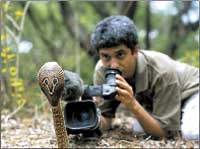
Shekar Dattatri - All Things Wild and Wonderful
However, this much is evident - meeting Shekar is like being swept away in a deluge of anecdotes and sound-bytes. He speaks of his early introduction to the wild when his sister gifted him a book by Gerald Durrell and his discovery that one doesn't have to go into the jungles to watch animals, the ones in the backyard were just as interesting. At age 13, he remembers cockily asking Rom Whitaker if he could join the Madras Snake Park as a volunteer as he already knew how to handle snakes. Rom agreed with the usual word of caution, and Shekar began to spend his weekends there, gradually progressing to accompanying snake-catching Irula tribals on trips. When he attended school during the week, he sat in the last bench, immersed in books on wildlife.
Shekar then began going further afield on surveys that helped him get attuned to the jungle and, along with the knowledge gleaned from extensive reading, he began the long process that led to becoming a wildlife filmmaker. This quest for knowledge of the natural world is evident in every anecdote that Shekar narrates, be it about crabs grinding sand pellets on the beach at Point Calimere or a tiger trailing a mother rhino and her calf at Kaziranga.
One audience that Shekar would like to focus on, is children - "Children are like sponges – they soak up so much information and are yet to become cynical. Given the right information, they'll grow up to be a generation that's much more proactive and conscious of these issues. As part of the Rolex Award, one of my objectives is to build a body of work with short films on different issues which could help equip school libraries, and be played during environmental science classes.", he says.
Which brings us to the general impression of wildlife filmmaking being a very macho vocation, with images of striking cobras and attacking leopards coming to mind. "Yes, there's adventure around every corner, but if you ask me, I feel much safer amidst wildlife in a jungle – it's cities and people that I'm wary of!" he says.