Wednesday, November 15, 2006

Traditional Indian Flooring

Imagine the harsh summer sun, beating down on you. There’s no respite from the hot winds blowing across the streets. Until you step barefoot, into a traditional built Indian home. Cool tiles underfoot soothe your soles, relieving all manner of tiredness, and in short, welcome you into cool confines, insulated against the worst of summer heat.

Different parts of India have their own flooring traditions, dependent on locally available raw material, craftsmanship and the extent of use of cultural symbols.

Athangudi tiles, named after the place in Chettinad, Tamil Nadu, where they are manufactured, come in myriad colours and patterns and are made by a unique process, using local soil. These tiles are testimony to the rich cultural heritage of the Chettiars, who traded extensively in the days of yore, especially with Burma. The Chettiars effectively adapted many an influence, to their own brand of local craftsmanship. The designs and colours used in Athangudi tiles are still those of a bygone era, with minimal contemporisation.

Recycling has been a concept that has long-existed in India. Traditionally, cow-dung was used to plaster flooring. Mandana is one such tradition, from Rajasthan, where red clay and cow dung are mixed to make the floor. It is then painted with traditional symbols with rice paste and coloured powders.

Terracotta tiles have graced many an old bungalow of the British Raj. Red Oxide was used to polish it and give it that unique texture and to deepen the reddishness of the terracotta. Clearly, local materials and techniques were used to good effect in those days to minimize the effects of the harsh tropical weather.

While Mandana and Athangudi tiles are patterned, the latter also come in unpatterned rich colours. Terracotta tiles come in a fixed range of earthy colours, depending on the place from which the clay originates.

There is a resurgence of demand for these seemingly rustic flooring options, as more and more people are looking to merge the contemporary with the traditional to give their homes a unique identity. Not to mention, that the options are eco-friendly and ideal for tropical weather.

Compared to most modern flooring options, they are also more cost-effective. Also, architects are returning to old materials and techniques, to give a fresh, yet traditional perspective to contemporary spaces.

 Pic by author
An edited version of this article was published in the October 2005 issue of At A Glance.

Mumbai

Mumbai’s skyline at night is reminiscent of New York. Come to think of it, there’s a similar energy to New York that pulsates through Mumbai. Just get swept into a Mumbai local train at rush hour, and you’ll realize what I mean. It’s a city that indeed doesn’t sleep.

Previously known as Bombay, the city Mumbai as we know it today, was formed by the merging of 7 islands. In addition to Bombay itself, the islands were Mahim, Parel, Worli, Mazgaon, Old Woman’s Island and Colaba.
Today, Mumbai is regarded the commercial capital of India, with many financial institutions and companies having their headquarters here. It’s also the film capital, with Bollywood (aka the Hindi film industry) providing much fodder for film-crazy masses, star struck tourist hoardes and gossip columns of local publications. With so many dream merchants based here, is it any wonder that it’s called the ‘City of Dreams’?

In fact, this adage has been in use at least conceptually since the textile boom in 1800s, with many mills and the Sassoon Docks, providing employment to countless hoardes.
Multitudes of rural immigrants continue to throng Mumbai in the hope of making it big in life. Housing crises have impelled the formation of new localities like Navi Mumbai (New Mumbai) and suburbs like Thane and Vashi. Yet, a central location continues to remain of utmost importance and as a result, slums and tenements populate every available inch of space in the main city.
Mumbai is as cosmopolitan as they get. With the choicest retail outlets, pubs, restaurants and pavement shops, Mumbai makes for a terrific tourist destination. South Mumbai, especially the Fort area and Colaba boasts of numerous heritage buildings and museums that are the architectural legacy of the British Raj. The Gateway of India, as much an emblem of India itself, as of Mumbai, was erected in 1911 to commemorate the visit of King George V and Queen Mary, to India.

Being surrounded on three sides by the sea, no discussion of Mumbai is complete without mention of its numerous beaches. Chowpatty, Juhu, Worli Seaface and Bandra Bandstand are the main beaches, frequented by families, romancing couples and lonesome souls - walking the promenades or strolling the sands, munching peanuts or spiced sweet corn.

With its range of cuisine from Japanese to Bengali to South Indian, Continental to Gujarati to Parsi, Mumbai is an epicurean heaven. Street food was never more interesting, with local fare like Vada Pav (also called the Indian burger) and Chaat (a range that includes Bhel Puri, Pani Puri, Pav Bhaji and variations thereof).

Mumbai does induce a sense of overwhelm, but that’s the essence of the city. The crowds, the food, the traffic, the hawkers. It’s a city of excesses, and in many ways, some entirely welcome excesses at that.

(an edited version published in the November 2005 issue of At A Glance)

Thursday, November 02, 2006

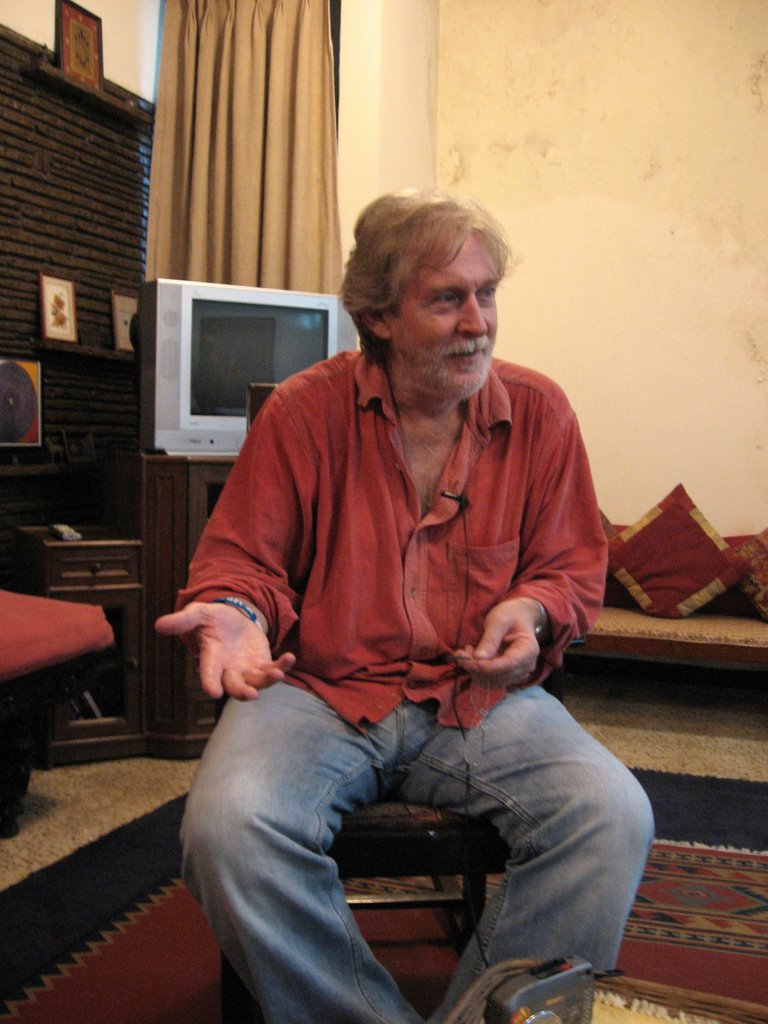
The Many Faces of Tom Alter

"I've acted in over 250 India films in the last 33 years and it still amazes me that people ask if I knew Hindi.", he muses. "Although 50% of the roles I have done are for the money, I have only acted in 10 films as the quintessential Angrez but been bracketed as one for years. Nobody wonders about the balance 240 films in which I don't play an angrez speaking bad Hindi." Says the actor perhaps best remembered for his role as the sensitive Captain Weston in Satyajit Ray's Shatranj Ke Khiladi (1977).

Perhaps the best known face of the angrez (Englishman) in the hindi film industry, Tom was born in India at Mussoorie and went on to ultimately do a course at Pune's FTII (Film and Television Institute of India).

His first role in a feature film was in Charas (1976) and his latest, is in Alag (2006). Tom looks for a certain something in the characters he plays for the sake of the role. "If the role is meaty, I like to see some change, some colours in the personality. I like to see growth and change in the character. If I see that in the script, then I get very excited about the role, whether it has negative shade or positive ones."he says.

Tom has not only done Hindi movies, but also many regional films, including three Malayalam Movies ( I.V.Sasi's 1921, Priyadarshan's Kaala Pani and a film called Oru Thooval Pakshikal). Besides these, he has done two Bengali and one Kannada Movie, the latter was M.S. Sathyu's Kanneshwara Rama where he co-starred with Anant Nag, Shabana Azmi and Amol Palekar.

More recently, Tom has been part of two exciting theatre projects, an Urdu solo on Maulana Azad and the other, 'Mahatma and the Poetess' on the letters between Mahatma Gandhi and Sarojini Naidu.

Not many people know that Tom has also written three books. The first, a book on cricket called The Best In the World, was co-authored by Ayaz Memon. His other two books are novels, Rerun at Rialto and The Longest Race, both set in his hometown, Mussoorie. "I want people to read with the same passion with which I write. I wrote 'The Longest Race' in a particular way, it is very critical of the athletic system." He says

Which brings us to his passion for sports, especially cricket that he also plays. He has also written extensively for Sportsweek. As a sports enthusiast, he has been credited with organising the first national triathlon in the 1990s with swimmer Anita Sood and swimming coach, the late Sandeep Divgikar.

"While my publisher has asked me to write another novel, what I really want to write about is change.", he says, "It's a strong thread that runs through my books. More importantly, I'm questioning if so much change is really necessary. Things are changing, but are they improving? The more the changes, the faster the spiral. " he says.

(an edited version published in the November 2006 issue of At A Glance. Photograph by author.)

Nagesh Kukunoor

Introductions are passe when it comes to Nagesh Kukunoor. It’s well-known that this NRI returned to India to make his first feature film with a meager budget, even playing the lead role himself. Hyderabad Blues touched a chord and everyone was talking about this hilarious film about an NRI and his family’s attempts to get him married.

Then came a string of films as varied from each other as they could possibly get (see filmography), but all having those little nuances that define a Kukunoor film. And the nuances are aplenty in Nagesh’s latest film, Iqbal.

Sitting cross-legged on a sofa, in the midst of much post-release activity at the producer’s office, Nagesh Kukunoor says, “Iqbal is the classic underdog tale. If you look at the poster, you already know what the ending of the movie is. But it’s the way that the tale is told, that makes the difference.”

Iqbal, is the story of a hearing and speech impaired person (Shreyas Talpade) from Kolipad village, who aspires to bowl for the Indian cricket team. He has the support of his mother and his sister (Shweta Prasad), and later, an alcoholic ex-cricketer (Nasseeruddin Shah), who coaches him. But the mainstay of this film is not Iqbal’s disability, it’s his unwavering focus and determination.

Speaking of the challenges of making this film, Nagesh says, “The longest time I’ve spent on casting was possibly for the character of Rajesh Naidu in Rockford. After that, it’s been Iqbal. I wanted the right Iqbal - not just someone who could act, but also fast-bowl and barefoot at that. To top it all, I wanted someone who could put in the dedication required to learn sign language and make it look effortless on screen. Which is where Shreyas Talpade came into the picture. I looked at about 200 cricketers for the role, and found they just couldn’t act. Then, I looked at actors who could look like fast bowlers, and that was even worse in some respects. Then, Yateen Karyekar, who plays Iqbal’s dad in the movie mentioned that there were a lot of Marathi actors who are also good at cricket. One of them was Shreyas and we zeroed in on him after separate screen tests for acting and bowling. If you look at the sign-language interactions between Shreyas and Shweta, it’s so effortless and natural. This was what I wanted and got.”

One question that often arises when it comes to Nagesh’s films, is the obvious lack of song sequences. It’s a marked departure from the Indian film format. Nagesh has this to say about it, “While I’ve grown up with Bollywood, I’ve developed my sensibilities as an adult, by watching movies from the West. As a result, I’m unfamiliar with how to handle a format with songs, like it’s done in Bollywood.”

“If you see my movies, you’ll notice that I’ve grown as a person. While Hyderabad Blues was an outsider’s perspective (albeit an NRI’s), Iqbal can’t get more Indian. I have scripts where the protagonist is white, and that’s the prerogative I take as a writer. But as a director, I can adapt the story any which way I want to.”

Coming back to Iqbal, it is not very different from his other movies, yet, there seems to be a conscious need to make a completely feel-good film. “There’s a great deal of cynicism that has crept into our lives. I’ve noticed this of myself too. Somewhere along the way, our optimistic side gets buried. Which is where we need a film like Iqbal that can energise us to go chase our dreams.” replies Nagesh.
KUKUNOOR SPEAK:
- If you want something badly enough, you’ll figure out a way to get it. The key thing is to ‘want badly enough’.
- If you dream of making a movie, it’s entirely up to you how to go about it. You could either get trained under a good director for a few years or like me, just go ahead and make that movie by using your savings.
- I believe that there are some basic rules that one follows in genres of film-making. If one breaks the rules, it has to be conscious. Like in Teen Deewarein, it starts out being a drama and then becomes a thriller. That was deliberate.

FILMOGRAPHY
- Hyderabad Blues – 1998
- Rockford – 2000
- Bollywood Calling - 2001
- Teen Deewarein – 2003
- Hyderabad Blues 2 - 2004
- Iqbal – 2005
(an edited version published in Java Connect)

Indian Street Food

It’s a given that India is a gastronomic heaven. Perhaps nowhere is this more evident than on Indian streets with its diversity of street food.

There are regional specialties like Jhaal Mudi (made with rice crisps, onion, mustard flavour and nuts) and Vada Pav (akin to a burger). Then there are generic favourites like fritters – bajjis, pakodas and bondas. Not to mention desserts like kulfis and jalebis to cater to those who’d like to end their street food meal on a sweet note.

Typically, a street food vendor pitches his stall or his cart at a standard location, and makes his wares on the spot. There is a plethora of street food options in India – here’s a rough categorisation.

BEVERAGES: Tea, Coffee, Masala Tea, Masala Milk etc. with biscuits as accompaniments.
MEAL STALLS: They serve only lunch and dinner – rice with vegetable or chicken gravy, chapathis or pooris with a vegetable, idlis/dosas/vadas etc.

SNACK STALLS: These are quick bites and the stalls are most frequented mid-morning or early evening. Sandwiches, Katti Rolls (similar to a spring roll), bajjis/bondas/pakodas (fritters), fruit salads etc.

SPECIALITY STALLS: These serve only one item that’s their core competence. For example, Dosas, Momos, Vada Pav and Pav Bhaji (bread mounds with mixed vegetable gravy). By the way, the word Pav is derived from the Portuguese term for bread, Pao.

CHAAT STALLS: Perhaps the most kind, with Bhel Puri (puffed rice with chopped vegetables, crisps and spices), Pani Puri and other items like Sev Puri, Dahi Puri, Papdi Chaat etc. Chaat is always served cold or at room temperature.

Mumbai, Delhi and Calcutta are all credited with their own versions of chaat. Case in point – the humble Pani Puri. This is a crisp hollow bite-sized ball, filled with mildly spiced boiled potatoes, dipped in two syrups(one sweet and one sour), and then served. This is simply popped into the mouth one at a time. While it’s generically called Pani Puri, the Delhiites know it as Golgappas and those from Calcutta have savoured it as Puchka. While the basics are essentially the same, there is simply a minor variation in flavour and ingredients.

Innovation is a buzzword even in street food. While hygiene is a factor that is touched upon for street food, enterprising vendors use only mineral water and the freshest of ingredients. To cater to the Jain community, Jain variants have been created without onion and garlic. Not to mention Diet Bhel / Diet Vada Pav for the calorie conscious!

So, how do you find out which vendor serves the best street food? Look for the most crowded stall!


An edited version of this article was published in At A Glance.


Nandita Das


Nandita Das represents an emerging breed of individual – the Social Communicator. I suppose that at least attempts to sum up a person who's a renowned actor and an activist. Then again, it doesn't quite encompass all that she has accomplished.

Based in Delhi, far from the glitz of Mumbai's film industry, Nandita has been critically acclaimed for her roles in Mira Nair's 'Fire' and 'Earth', Mrinal Sen's 'Amar Bhuvan' and Jagmohan Mundhra's ' Bawander', Nandita has gone on to do popular cinema too, with films like 'Aks', 'Bas Yun Hi' and 'Supari'. She's considered one of the few actresses who excels in both streams, not to mention in regional cinema too. In fact, the last is a list in itself – Tamil, Bengali, Malayalam, Gujarati, Kannada and Oriya. For now. She considers only the overall story when signing a film and doesn't hesitate to explore new subjects.

Take for instance, her role in Shyam Benegal's 'Hari Bhari' where she plays an ignorant, woman with a sharp tongue. It's a complete antithesis to the person she is. While she initially did have reservations playing the part, she finally did go on to play Afsana with aplomb.

There has been recognition aplenty – Nandita was adjudged Best Actress for her performance film 'Bawander' at the Santa Monica Film Festival (2001) and won another Best Actress award for her performance in 'Amar Bhuvan' at the Cairo Film Festival (2002). However, she considers the experience of being part of the Feature Films Jury at the prestigious Cannes Film Festival, as one of the most enriching. She participated in discussions with some of the most talented people in the arts – some of her fellow jury members were writer Toni Morrison, Director John Woo and actress Salma Hayek.

Nandita supports social causes that are close to her heart, mainly in the area of peace and the rights of women and children. She has no qualms in admitting that she is merely a communicator of the good work done by NGOs. This aspect of being a social communicator however, has led to an organization, Leapfrog, that Nandita founded with her husband, Saumya Sen. Under the banner, she has directed four public service short films.

Another aspect of her communicator self comes across in her role as a story teller. Literally. She has been a narrator for a series for Karadi Tales' folk story audio books, 'Under the Banyan' and most recently, the audio book on Gandhiji's ' The story of my experiments with truth'. So, what does Nandita herself have to say about her many facets? "Everything I do is part of a core belief system. It just expresses itself in different ways.", she says.

(an edited version published in the January 2006 issue of At A Glance)

High & Dry in Mumbai

The day I left Chennai to begin a new life in Mumbai in late June this year, emails from friends started pouring in. “Hope you’re having fun in the rain - we lesser mortals are languishing of thirst in Chennai.” “All settled in? You must be – with water in taps, what more do you need?” All in jest, but badly timed.

Having lived in Chennai for 16 years, sunk roots, made some deep friendships and dreamt some Chennai-based dreams, it seemed as though it would all end with my move. I detested Mumbai for its alleged squalor, its pace, its distances. But with no option but to move, I steeled myself for the challenges that the change would bring with much proclamations of “You’ll love the place!” from my husband.

Friends tried to dissuade us, colleagues warned us of the fast pace of life there, but in every conversation, I could detect a veneer of envy. I, for one, was beginning to look at the plusses.

No more auto drivers, doing that swift mental juggling of variables to arrive at the rate, in the nanosecond it took for you to say “Airport?”, and him to say “Rs. 250.”

No more undisciplined ‘over-takers from the right’ – one could now peacefully erase from memory, choice phrases like ‘Savugiraki!’ and ‘Veetule Sollittu Vandhuttiya?”

Above all, no more water problems – there would be enough water to warrant the ownership of a washing machine. More importantly, under a shower in the bathroom, one could, at least in some small way, begin to finally fathom why all those film heroines under waterfalls, almost always broke into song.

Gradually, I began to get attracted to the notion of being a Mumbaikar. I was going to become a chilled-out bindaas babe.

Once the move happened at the beginning of the Mumbai monsoon, it didn’t take long for the truth to seep through my cranium.

All that I had fantasized about – water in taps, meters that worked and orderly traffic – it took less than a week for the novelty of these to wear off.

I missed Chennai.

I missed the morning walkers and evening hawkers of Marina Beach. I missed the kitschy charm of Pondy Bazaar. I missed theatres where I’ve watched many a movie alone, without worrying about which letch was sitting next to me. I missed Spencer Plaza, where I spent many lazy afternoons window-shopping dreams of depleting the husband’s income. I missed the discount sales at the various exhibition halls. And friends – no more hot gossip sessions over cups of even hotter coffee. Most of all, being the self-confessed foodie, I missed sambar of the non-sweet kind and coconut chutney. I missed the bajjis, peanuts and sundal on the beach. And my mouth watered at the memory of adai, appam, and steaming hot masala milk.

While I fantasized about the aroma of set dosas in hole-in-the-wall eateries in Chennai, things weren’t going very well for me in Mumbai. The expansive supermarket near home stocked a vast array of nearly-expired snacks on discount, totally useless photo frames and an unusually large variety of car accessories. What it didn’t stock, were those little essentials that we can’t do without – cloth clips, buckets, dust bins. Another revelation was that people don’t make social calls on their friends during the week. And weekends are a parking nightmare practically everywhere. Movie tickets in the more decent theatres costed the earth and parking there, the moon.

On her first day at work in my home, the Bai left the tap in the kitchen sink open while she went about cleaning the counter. As soon as I heard the water, images of our water-starved life in Chennai gushed forth, unbidden. I couldn’t stand there silent, while she let down the drain, the equivalent of an average Chennaiite’s precious bucket of water for the bath. So, I advised her that she shouldn’t be wasting water, when parts of India (Chennai, for instance), was reeling under a water shortage situation. She stopped, as though someone had shouted ‘Statue!’, cocked her head, and asked, “Aaiga! No water? Why?” I wish I knew. How does one explain water shortage to someone who wades through knee-deep water to get to work?

But what changed my perspective on the city, was this. On Torrential Tuesday or Thunder Tuesday or whatever the media is calling it now, life came to a grinding halt in Mumbai.

I’d love to have been out there, battling the surging waters, giving a helping hand to people stuck in the flood – at the very least, I’d like to have participated by being stuck in a traffic jam! But there I was, in the comfort of a 11th floor apartment, watching the scenes unfold on TV – a mere spectator. I was, pardon the term, literally high and dry. The large window of my living room, provided a very dismal view of the rain pouring down, as though some wrathful higher being had upended a large drum of water.

Mobile networks were jammed, telephone lines were down and power was cut off in some of the suburbs. The people of the city showed more gumption and spunk, by taking things in their stride. When taxis or buses broke down, people got off, and started the long walk home, some through over 15 kilometres along roads with water logging at depths varying from ankle-deep to chest-high. Cars, some very expensive ones too, floated about like paper-boats. Someone I know reached home 26 hours from the time he left office. Along roads, in some places, people distributed home-cooked food and drinking water to those who were trudging home. Some played anthakshari while waiting it out at office. Those stranded in cars, passed the time listening to those annoying rain-themed songs on radio. The radio stations got going on transmitting messages from people in search of their loved ones, the TV channels followed suit.

On the one hand, my first thought was that Chennai would be better off with even a fraction of those 944 mm that descended on Mumbai that day. On the other hand, I’m beginning to think that like the infamous Chennai summer, the nemesis for Mumbai is its monsoon.

This much I know, no matter how bad the water problem or the summer heat in Madras, it didn’t ever get to the point of the city becoming paralysed. While in Mumbai, the rain played games with us – letting up for a few minutes just to get our hopes up, and then proceeding to empty more dark clouds. So, today, my husband grapples with how he is going to make sales calls in this water-logged city, while I worry about whether we will get supply of vegetables and milk.

So, before you curse those of us who have moved out of Chennai, remember – the water is bluer on the other side!
(an edited version published in Eve's Touch)